I build agentic AI systems, from local LLM assistants that run on your own hardware to
a clinical-trial screening engine that shows its proof for every answer.
I'm an AI engineer and the founder of NeuralAI, based in Thessaloniki, Greece.
I take complex ideas from concept to working product: system design, AI-assisted development,
and the testing that keeps it all honest.
My first big project, S.A.G.E., is an 8-billion-parameter local LLM assistant that I
presented at the 18th Student Computer Science Conference. Since then I've built
A.P.E.X., Aeron, Aurelix and
Quorum, an agentic system that checks patients against real clinical trials,
criterion by criterion. Quorum started at the GenAI Summit Hackathon in Athens and is now being prepared for market release.
I care about AI you can trust: code that checks the model's work, quotes that must really exist, and
numbers measured on blind tests rather than guessed.
Based inThessaloniki, Greece
CurrentlyFounder, NeuralAI
LanguagesGreek (native) · English (C2)
AlsoEASA-Certified UAS Remote Pilot (A1/A3, A2)
0AI systems built
0automated tests in Quorum
0planted errors caught
40–80×faster knowledge retrieval in S.A.G.E. (from 2–4 s down to ~50 ms)
02 · Projects
Things I've built
Some projects are in private repositories. You can still read the full case study, and if you'd like to see the
code, request access and I'll add you as a collaborator on GitHub.
Private11/2026 – Present
Quorum
Every clinical trial your patients qualify for, with the proof.
An agentic AI system that checks patient notes against recruiting trials from ClinicalTrials.gov, criterion by criterion.
Every answer shows exact quotes that code verifies. Where the note is silent it asks the doctor, and the doctor decides.
An agentic assistant that sees, listens and gets things done.
A Python/FastAPI brain on DeepSeek with long-term memory, live voice, camera vision, and email, calendar and device tools,
plus an Autopilot agent that does work on your PC.
A universal AI translator for everything you see and hear.
Translates web pages, images, subtitles, dubbed video and live audio into the language you choose, with per-feature opt-in.
It runs on a verified multi-agent engine and has an MCP server so other AIs can use it.
The next generation of S.A.G.E.: a local-first assistant on a 30B mixture-of-experts LLM (3B active parameters)
that decides when to call its agents for smartphone control, live web information and timekeeping.
My first AI personal assistant: an 8B local LLM with a QLoRA fine-tuned coding model, a local Wikipedia knowledge base
and Android, desktop and web clients. Presented at the 18th Student Computer Science Conference.
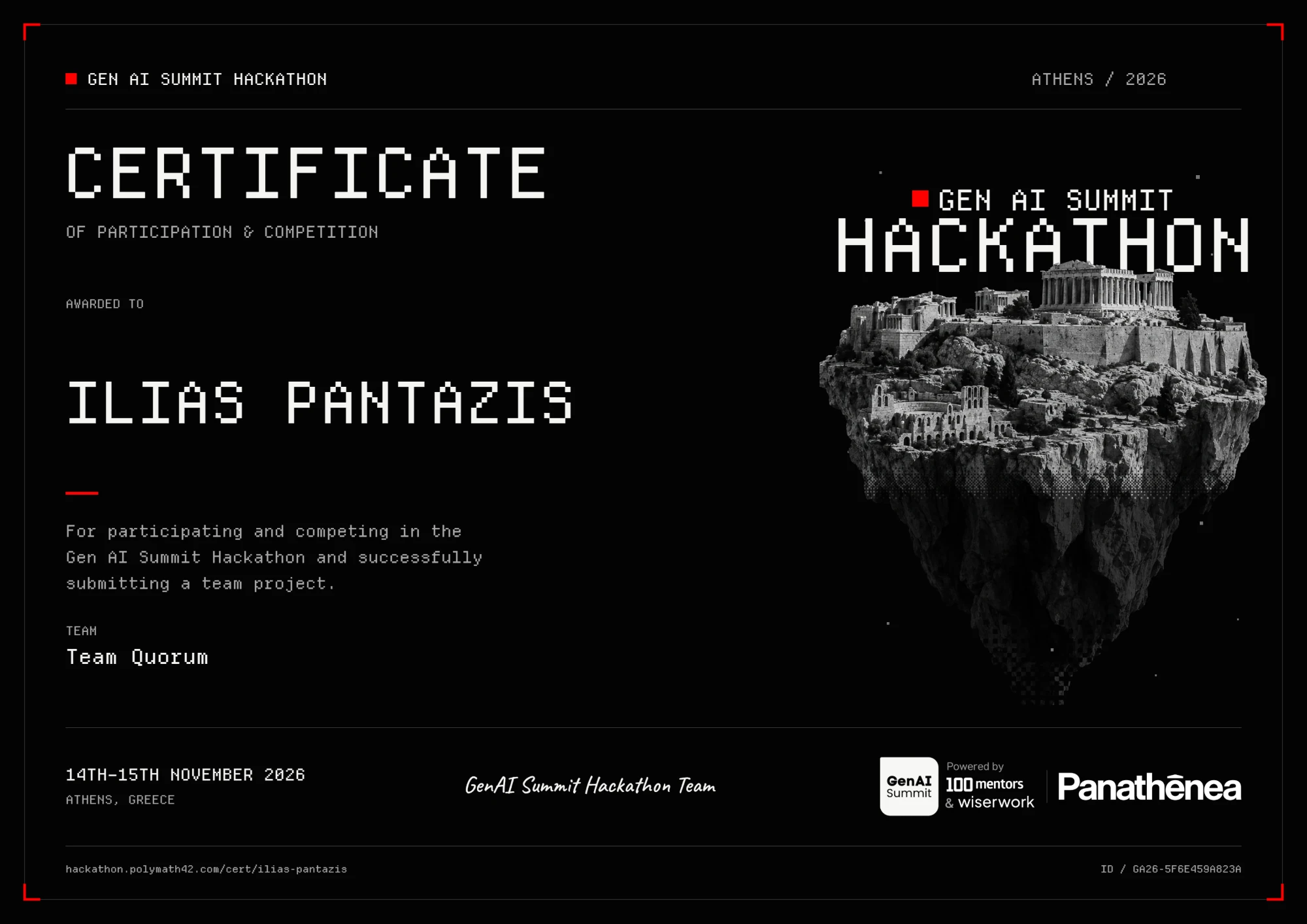
Competed on 14–15 November 2026 and submitted Quorum, an agentic AI system for clinical-trial patient screening. I now own and develop it on the way to a market release.
Presented S.A.G.E. to students and professors, received very positive feedback and an invitation to present it at other schools.
Mar 2026 – Present
Founder · NeuralAI
Self-employed · Remote
Building AI products end to end, from system design and multi-agent architecture to testing and deployment.
Jun – Jul 2025
CASSINI Space Camp
NOESIS · Thessaloniki
An intensive program on the space industry: team projects on space-tech, hands-on work with space data, and how AI and space data help with problems like climate change.
04 · Achievements
Hackathons & certificates
GenAI Summit Hackathon 2026
Certificate of Participation & Competition · Team Quorum · Athens, 14–15 Nov 2026
My core strength is AI-driven software engineering: I design the system, direct AI coding agents to build it,
and review, test and debug the code they write. I read and understand code well, and I write simpler programs and websites by hand.
AI-Driven Software Engineering
Core strength
System design: turning product ideas into architectures, specs and structured prompts
Directing AI coding agents to build complex, multi-part systems: backends, web apps, desktop and Android clients
Shipping with evidence: Quorum has 2,400+ automated tests and six blind evaluations
Code Review & Debugging
Core strength
Reading and understanding large codebases, mainly Python and JavaScript
Reviewing AI-generated code for correctness and security
Tracking down bugs, deciding the fix and verifying it with tests
Frontend Web Development
Hands-on
Building responsive websites by hand with semantic HTML, modern CSS and JavaScript
Directing and refining AI-generated frontend code
Python & SQL
Reading & reviewing Python
Proficient
Writing Python by hand
Simpler programs
SQL
Querying & filtering
Follow and reason about production Python: FastAPI services, agents and test suites
Write scripts with data structures, loops, control flow and try/except error handling
Microsoft Office Suite
Certified
Microsoft Office Specialist in Word, Excel and PowerPoint
Advanced document formatting, data analysis and formulas, presentation design
Languages
GreekNative
EnglishC2
SpanishBasic
FrenchBasic
Tools & technologies from my projects
llama.cpp
QLoRA fine-tuning
GGUF quantization
RAG & embeddings
ChromaDB
Model Context Protocol
Multi-agent orchestration
Neuro-symbolic architecture
OpenRouter
DeepSeek
FastAPI
WebSockets
Next.js
Electron
Flutter
Chrome extensions
faster-whisper
Coqui XTTS
SQLAlchemy
pytest
Docker
Git & GitHub
06 · Contact
Let's build something intelligent
I'm open to collaborations, projects and opportunities in AI and software. The fastest way to reach me is by email.
Every clinical trial your patients qualify for, with the proof.
The problem
A trial coordinator reads pages of eligibility rules by hand, for every patient and every trial. Most eligible patients are never told that a trial exists.
What Quorum does
It checks a patient against real, recruiting trials from ClinicalTrials.gov, criterion by criterion. Every answer (pass, fail, unknown or site to confirm) shows two exact quotes side by side, the trial's words and the patient note's words, and code verifies that both really exist. Where the note is silent, Quorum says unknown and asks the doctor. It never guesses. The doctor makes the final decision.
It works both ways: one patient against every trial (for a doctor), or one trial against a whole patient list (site pre-screening), with referral drafts for the doctor to review.
How it works
Fetch recruiting trials with an open site in the chosen place
Split eligibility text into criteria, word for word
Read: lightweight worker models answer and must quote both trial and note
Check: code verifies quotes, numbers, dates, units and time windows; a supervisor model checks the proof
Redo failed answers, escalating to a stronger model tier
Assemble: code, not a model, sets each verdict and ranking
Ask the doctor about unknowns; only affected trials are rechecked
Refer: proof table, site email and patient message saved as drafts
Results
79–88%criterion agreement across six blind tests
10/10planted errors caught
0trials wrongly called eligible
4–9¢per patient
Built with
A custom neuro-symbolic, multi-agent engine with no agent framework: language models read and reason, while deterministic code verifies their quotes, numbers, dates and units and sets every verdict.
Developed with AI coding agents: Python/FastAPI backend, Next.js web app, an authenticated MCP server and 2,400+ automated tests. Work is routed across worker (Qwen), supervisor (DeepSeek) and brain (OpenAI) model tiers via OpenRouter.
Started at the GenAI Summit Hackathon in Athens (14–15 Nov 2026) with Team Quorum and now being prepared for market release. Synthetic patient data only; decision support, not medical advice.
An agentic AI assistant that sees, listens and acts across all your devices.
Overview
Aeron is a full agentic assistant. Its brain is a Python/FastAPI service running on DeepSeek, with long-term memory so it remembers what matters across conversations.
It shares the neuro-symbolic architecture of Quorum and Aurelix: language models reason and act, while deterministic code checks their output.
Capabilities
Live voice conversations, including phone calls
Camera vision: images go straight to the model
Email, calendar and device tools it can use on your behalf
Autopilot: an agent that carries out work on your PC
Cost-aware routing: simple chat turns go to a low-cost zero-retention model and escalate when needed
Security: OAuth tokens encrypted at rest, a scoped MCP server with confirmations
Clients
Electron desktop app, web app, Flutter Android app and a Chrome extension, plus MCP support so other AI tools can connect.
Aurelix translates what you see and hear (web pages, images, subtitles, dubbed video and live audio) into the language you choose. Each feature is opt-in.
The engine
Model tiers: worker, supervisor and brain, configured per tier with direct-provider fallbacks
Neuro-symbolic verification layer: deterministic code checks (schema, rules, arithmetic, evidence quotes) run first, and a model judges only what code can't decide
Budgets & limits per task and per caller, with full tracing of where tokens go
Record & replay so demos keep working offline
Authenticated MCP server with personal access keys so other AIs can call it
Autonomous Personal EXpert: the next generation of S.A.G.E., with a new LLM architecture.
Overview
A.P.E.X. is a local-first AI assistant for everyday needs, information and coding help. It uses an open-weight 30B mixture-of-experts LLM with only 3B active parameters, and connects to the internet only when it needs real-time information. It speaks English and Greek.
Architecture
Brain: LLM inference on a local llama.cpp server, with a configurable personality and long-term memory in ChromaDB
Speech recognition with faster-whisper
Text-to-speech and voice cloning with Coqui XTTS v2
Agents the LLM decides to call: smartphone control, web search (Brave, DuckDuckGo, Wikipedia), time and alarms, social media
Strategic Analytical & Generative Engine: my first AI personal assistant.
Overview
S.A.G.E. supports everyday needs, answers questions, helps with code, and analyses images and documents. It gives real-time weather, controls smartphone functions, plays music, locates devices via GPS, manages phone calls and sets alarms, in English and Greek.
Under the hood
8B open-weight LLM, quantized and optimized with llama.cpp for mid- to high-end hardware
Coding mode: a 3B model I fine-tuned with QLoRA, then merged and quantized to GGUF
Local Wikipedia knowledge base; embedding-based retrieval cut latency from 2–4 s to ~50 ms
Backend AI server plus Android, desktop and web clients
Modules for calendar, Gmail, notes, system control, vision and security monitoring
Recognition
Presented on 23 April 2026 at the 18th Student Computer Science Conference at the NOESIS Science Center in Thessaloniki, which led to an invitation to present it at other schools.